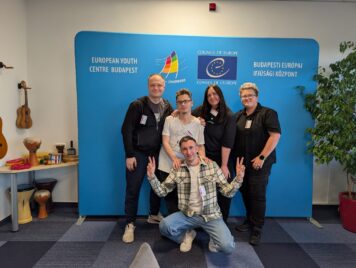
On 26–27 October, 40 LGBTIQ+ people from six Central and Eastern European countries met at the European Youth Centre in Budapest for the first International Queer Citizens’ Panel. Together, they discussed what EU policies are needed for a safer future for queer communities.
The panel brought together six participants each from Lithuania, Poland, Bulgaria, Romania and Slovakia, and ten from Hungary. It was hosted by the Hungarian organisation Háttér Society. The panel is part of the QuCEEr Future project, which LGL implements together with partners from across the region.
Citizens as experts of their own lives
This was not a typical expert conference. The panel followed an adapted citizens’ assembly format, in which each participant took part as an expert of their own lived experience. Over two days, participants:
- compared the situation of LGBTIQ+ people in their countries;
- identified common barriers that communities face across the region;
- learned about successful citizen initiatives and how EU institutions work;
- deliberated, set priorities and drafted the first set of recommendations.
The discussions showed that, despite different national contexts, the challenges are often similar, and so are the sources of strength and solidarity.
What comes next
The draft recommendations will be developed further in 2027 through co-design workshops in each partner country, including Lithuania. A second international panel will take place in Bulgaria at the end of 2027. The final outcome will be an LGBTIQ+ Citizens’ Report, presented to EU institutions and national governments.
QuCEEr Future (2026–2027) is led by LGBTI Deystvie (Bulgaria) with Single Step (Bulgaria), Háttér Society (Hungary), LGL (Lithuania), KPH (Poland), ACCEPT (Romania) and SAPLINQ (Slovakia). We thank all participants for their openness and the Háttér Society team for their warm welcome in Budapest.

Funded by the European Union. Views and opinions expressed are however those of the author(s) only and do not necessarily reflect those of the European Union or the European Commission. Neither the European Union nor the granting authority can be held responsible for them.