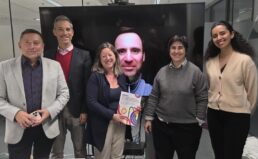
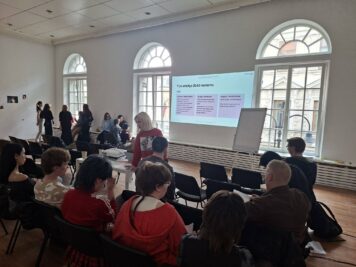
Lithuanian Gay League (LGL) brought together more than 20 LGBTIQ+ community members, activists, and allies for a Foresight Workshop, a participatory day of imagining what Lithuania could look like in 2040 if queer people were not just surviving, but staying, creating, and thriving.
The workshop was the Lithuanian chapter of QuCeer Future, an EU-funded project (CERV programme, Grant Agreement No. 101253313) that unites six LGBTIQ+ organisations across Central and Eastern Europe: LGL (Lithuania), LGBTI Deystvie (Bulgaria), Háttér Társaság (Hungary), Kampania Przeciw Homofobii (Poland), ACCEPT (Romania), and SAPLINQ (Slovakia). The project’s mission is to amplify queer voices in shaping Europe’s future and to identify the policy and practice gaps that stand in the way.
What happened
Rather than focusing on the urgent crises of today, the workshop deliberately looked further ahead. Participants were invited to think in decades, not news cycles, and the day moved through several stages:
Horizon scanning. Together, the group mapped the legal, political, cultural, and technological trends already shaping queer lives in Lithuania and the wider region, naming both the threats on the horizon and the opportunities worth fighting for.
Scenario building. In small groups, participants drafted three possible visions of 2040: Europe as an LGBTIQ+ sanctuary, a Europe sliding into backlash and regression, and a more radical “queer revolution” reshaping institutions from the ground up. Each scenario forced the room to ask: what would it actually take to get there?
Gap analysis. Participants compared today’s policies and protections against the futures they had just imagined, and prioritised the most urgent gaps in Lithuania, from legal recognition to everyday safety, mental health support, and rural inclusion.
Letters from the Future. The day closed with participants writing letters, to themselves, to policymakers, and to institutions, from the perspective of a 2040 in which things had gone right. These letters are not just personal artefacts; they will travel with the project as evidence of what the community is asking for.
What happens next
The findings, scenarios, and letters from Lithuania will feed into the International Queer Citizens’ Panel in Budapest, where outcomes from all six countries will be synthesised into a shared vision. From there, the conclusions will inform direct advocacy towards EU institutions and national governments turning a one-day workshop in Vilnius into part of a much larger European conversation.
Our voices and visions are already on their way to Budapest, and onward to Brussels.
The QuCeer Future project (No. 101253313) is funded by the European Union under the CERV (Citizens, Equality, Rights and Values) programme. Views and opinions expressed are those of the authors only and do not necessarily reflect those of the European Union.