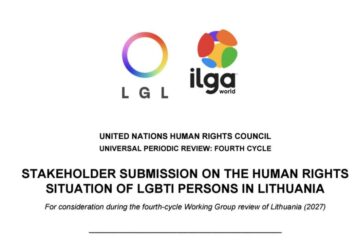
Together with ILGA World, LGL has filed a stakeholder submission to the United Nations Human Rights Council’s Universal Periodic Review, ahead of Lithuania’s fourth-cycle review in 2027. The submission assesses Lithuania’s record on sexual orientation, gender identity, gender expression and sex characteristics from January 2022 to June 2026.
Every UN member state has its human rights record reviewed by the other states roughly every five years, through the Universal Periodic Review. Ahead of each review, civil society organisations can file their own account of the situation on the ground, which feeds into the material other governments draw on when they decide what to raise. LGL has engaged with Lithuania’s review in every cycle since the first.
One figure captures the reporting period. At its third-cycle review in 2022, Lithuania accepted all twenty-nine recommendations that addressed sexual orientation, gender identity, gender expression and sex characteristics. By our assessment, two have been implemented. Both were given effect by the Constitutional Court, not by parliament or government.
That is the story the submission tells: progress has come through the courts, while legislative and policy implementation remains fragmented, and in several areas is now being contested from inside the State itself.
The courts move, the government resists
In April 2025 the Constitutional Court held that the failure to provide any framework for same-sex partnerships was unconstitutional, and opened a route for couples to have their partnerships recognised through the ordinary courts. That August, a Vilnius court recognised a same-sex partnership for the first time, and other couples followed. It is a real remedy, but a narrow one, placing the burden, cost and delay on individual couples, one case at a time, when the obligation is on the legislature to pass a law.
That law has not come, and the reason is no longer simply inertia. In September 2025 the Minister of Justice stated that she would not prepare partnership legislation, and the Government Programme published that month contained no commitment to it. When a cross-party group of members of the Seimas introduced their own amendments, she confirmed her faction would not support them. The Ministry has since begun appealing the very court decisions that register partnerships: by May 2026 the courts had recognised twenty-four partnerships, with a further twenty-three cases pending, and the Ministry had appealed four, stating that it sought to postpone registration. In June 2026, more than thirty organisations urged the incoming coalition not to reappoint the Minister, citing her failure to implement final court rulings.
The courts have not been uniformly protective. In March 2026 the Supreme Court reinstated the head of a hospital psychiatric unit who had publicly described homosexuality as a disorder and a perversion, holding that he had spoken as a private individual. With no law against conversion practices and no dedicated regulation of psychological practice, an employer’s code of ethics was effectively the only accountability tool available, and the ruling has narrowed even that.
Seven areas of concern
The submission documents seven areas: an equality framework that still omits gender identity, gender expression and sex characteristics; the absence of partnership legislation despite the April 2025 ruling; hate-crime cases that fail on procedural thresholds rather than on the bias motivation itself; the continuing lack of a legal gender recognition procedure based on self-determination, nearly two decades after the European Court of Human Rights required one in L. v. Lithuania; legislative proposals that would narrow inclusive education; threats to LGBTI assemblies and human rights defenders; and insufficient safeguards for LGBTI asylum seekers.
It also places these developments in context. In January 2026 the Seimas hosted a conference on family policy at which the president of the Polish organisation Ordo Iuris, which campaigns against LGBTI equality across the region, gave a keynote address and met the Minister of Justice. Eight weeks later, bills narrowing inclusive education were registered in parliament, co-signed by the Minister.
What we are asking for
The submission puts nine recommendations to the Lithuanian State, each linked to the issues raised. Among them:
naming gender identity, gender expression and sex characteristics in the Law on Equal Treatment and the Criminal Code; adopting gender-neutral partnership legislation that implements the Constitutional Court’s ruling, rather than leaving the question to be litigated couple by couple; adopting and funding a national SOGIESC equality action plan; issuing binding police and prosecutorial guidance on bias-motivated crime, with published disaggregated data; and enacting a legal gender recognition procedure based on self-determination.
These now enter the record that other States will draw on when they review Lithuania in 2027. LGL will continue to engage as the review approaches.
With thanks to ILGA World for its collaboration on this submission.