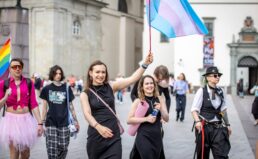
On 22 October, the conference “A Bridge to Work for LGBTI+ People” was broadcast from Vilnius. It concluded “Connecting the Dots”, a two-year EU co-funded project, yet its main message was not about endings. It was about the fact that a bridge to work has to rest on solid economic and social foundations.
Monday morning at the coffee machine
Picture a Monday morning in the office kitchen. One colleague talks about a weekend at the seaside, another about the wedding she is planning, a third about Sunday lunch with the in-laws. Then someone turns to you: “And how was your weekend?”
For most people, it is the easiest question of the week. For an LGBTI+ person, it is a small test: partner, friend, roommate, or “nothing special”? In two seconds you edit your life, smile, change the subject – and do the same again next Monday.
This was the image with which Monika Antanaitytė, a lawyer representing LGL, opened the conference. As she put it, almost every young jobseeker asks themselves whether they will cope with the job. But a young LGBTI+ person also asks a second question: will I have to hide who I am at work?
The project set out to reach 120 young people who are not in employment, education or training, offering them individual career counselling, soft-skills training and connections with inclusive employers. It was implemented jointly by LGL, the Lithuanian Diversity Charter Association and the Bulgarian foundations Bilitis and GLAS.
Opening the conference, LGL’s executive director Vladimir Simonko recalled that before founding the organisation he had worked for eight years as a sound engineer at the Lithuanian Film Studio. He himself once had to choose between openness and his career, and that choice sparked more than 30 years of activism.
Safety and trust first, the CV second
The main lesson of the two years, according to Monika Antanaitytė, is simple: CVs, skills and internships matter, but they come second. Safety, health and a sense of belonging come first.
She reminded the audience how the very notion of workplace safety has changed. It once meant helmets and emergency exits; in 2022, the Lithuanian Labour Code defined mobbing, violence and harassment. Today every employer with more than 50 employees must have a violence and harassment prevention policy – and nobody asks any more why bullying at work is even discussed.
Silence at work has numbers. In Lithuania, only 21% of LGBTI+ people are open at work, compared with an EU average of 51%. According to Monika Antanaitytė, this comes at a triple cost: to mental health; to the emigration of young talent, which Lithuania, given its demographic situation, cannot afford; and to the energy spent on every edited story or invented “roommate”.
“We cannot ‘fix’ a person and then send them back into the circumstances that break them.” – Monika Antanaitytė, quoting José Ortega y Gasset’s idea “I am I and my circumstances”
Asked what support they needed, participants most often named not CV writing or job ads, but mentoring and psychological support.
Iren Stephanova, a psychologist and career counsellor from Bilitis who worked with participants in Bulgaria, said that some of them expected their dream job to appear as soon as they clicked “register”. The team therefore took a step-by-step path: initial interviews, individual development plans, strengths and boundaries, labour market research and interview skills.
Special attention was paid to rejection. As Stephanova put it, no matter how old you are or what your qualifications are, rejection happens, so you have to learn to accept it and move on. In the first meetings, young people worried most about two things: whether they would find a job at all, and how to present themselves professionally without hiding their identity.
Working with business and the power of play
The GLAS Foundation has been working with business for eight years. According to Dimitar Bogdanov, its network of inclusive companies, “Work It Out”, has fundamentally changed workplaces for many LGBTI+ people in Bulgaria. During the project, GLAS took part for the first time in mainstream career fairs, not only in Sofia but across the country. Asked how they convince employers, Bogdanov answered simply: they talk about the business case – a better environment for employees and the chance to attract some of the brightest minds in the community.
Bilyana Bogdanova spoke about community workshops using role play and the LEGO Serious Play method. In a safe setting, young people rehearsed presenting themselves, managing emotions and building resilience before facing a real interview. In her view, an inclusive environment is an abstract notion for many young people, so it is important to show what it looks like in reality, so that they know what to look for.
In the afternoon panel, Galina Georgieva, who brought the business perspective from Sofia, was blunt. Why do some companies still hesitate? “Because it’s easier,” she said.
According to her, there is a wide gap between diversity values written “on the packaging” or on a website and real inclusion. Closing it requires a concrete plan, trained recruiters and managers, and ultimately the engagement of the whole company. On top of that, start-ups and growing companies are fighting for survival in a wave of artificial intelligence and automation.
Ausma Minkauskaitė, project coordinator at the Lithuanian Diversity Charter Association, said that when looking for internships, companies were very keen to help, but finding actual placements was harder. In the IT sector in particular, entry-level jobs are increasingly being taken over by artificial intelligence. In the end, the young people joined teams in human resources, communications, IT and banking operations.
In her observation, the Lithuanian private sector sometimes fills legal gaps itself – for example, by funding parental leave for LGBT families out of its own budget.
The bigger political picture: Russian networks and billion-dollar sums
The workplace does not exist in a vacuum. Rémy Bonny, executive director of the Brussels-based organisation Forbidden Colours, pointed out that discrimination is costly not only for people: the studies he cited show that LGBTIQ+ discrimination costs around 1–2% of GDP.
According to Bonny, after the start of Donald Trump’s second term, US embassies in several EU countries sent letters to companies trading with the United States, urging them to abandon diversity, equity and inclusion programmes. He stressed, however, that the strongest wave of backlash has already passed, and companies, including American ones, are coming back. The strongest push comes from within – from LGBTIQ+ employees who refuse to be silenced – while EU law clearly protects against discrimination.
According to Bonny, over the past two decades the anti-LGBTIQ+ narratives have essentially been reignited by Russia, which built the so-called “Russian World” soft-power network and portrayed Europe as “Gayropa”. He mentioned troll farms on social media, ultra-conservative networks funded by Russian oligarchs such as the World Congress of Families, and a long-running campaign to have Vladimir Yakunin, former head of Russian Railways, added to the EU sanctions list. According to him, the sanctions were long blocked by Hungary and are now blocked by Bulgaria, so he urged the Baltic states to consider national sanctions.
Monika Antanaitytė added that, according to the European Parliamentary Forum for Sexual and Reproductive Rights (EPF), more than a billion dollars is being poured into the anti-gender movement in Europe. Bonny added that the annual budget of the three largest anti-LGBTIQ+ organisations alone equals the combined budgets of the 700 largest LGBTIQ+ organisations. The difference is that LGBTIQ+ organisations spend their funds mostly on services for the community rather than on campaigns.
The new development Bonny called a “sandwich”: alongside Russia, a second state sponsor has emerged. According to him, the US State Department has announced calls to fund groups inside the EU worth up to 22 million dollars, although he has heard that around 7 million will actually be awarded. One of the main targets of such lobbyists in Brussels is the Digital Services Act, which helps tackle online hate speech.
In Bonny’s view, advocacy cannot stop at politicians – it must also reach companies. He gave an example: a dating platform that had to be told that an anonymous profile is, for many LGBTIQ+ people, the only safe option.
Galina Georgieva suggested a pragmatic view: anti-LGBTI movements have always existed; they are simply more visible now. Instead of making excuses based on the state of the world, everyone can help at least one person or one organisation. Bonny’s outlook was unexpectedly optimistic: amid this geopolitical turmoil, he said, this is “Europe’s moment” to become a leader in democracy and inclusion.
Everyone can be an ally and create change
In short films screened between sessions, participants spoke for themselves. A young man from Cameroon, where homosexuality is a crime, said he came to Lithuania to be seen as a human being. During his internship in the financial sector, he felt not judged but accepted. Game developer Elia said that people she knows jokingly call the “I have a preferred name” box on job application forms the “don’t hire me” box, because once you tick it, you never hear back.
Jaime Romaní of the European Pride Business Network presented research showing that as many as 63% of LGBT+ people in Europe still feel unsafe at work. He proposed continuing the project’s experience through an international mentoring programme for young people.
At the end of the discussion, participants suggested steps employers can take as early as next Monday: lead by example, look at those hiding behind good-looking survey numbers, and show support openly. LGL called for LGBTIQ inclusion to be treated as part of occupational safety and spoke about the importance of openness. “Not everyone can be an openly LGBTIQ colleague right now, but everyone can be an open ally. Sometimes a small but visible sign is enough to make the environment safer for at least one LGBTIQ person, and that is already change,” said Monika Antanaitytė.
The project “Connecting the Dots” (ESF-SI-2023-SKILLS-01-0086) is funded by the European Union under the European Social Fund+ Social Innovation Initiative. Views and opinions expressed are however those of the author(s) only and do not necessarily reflect those of the European Union or the European Commission. Neither the European Union nor the granting authority can be held responsible for them