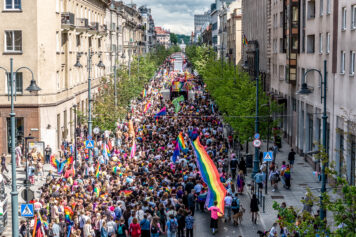
In the spring of 2027 (proposed date – March 7), Lithuanians will elect 60 mayors and their municipal councils. But the sponsors of an anti-gender initiative want voters to answer a second question on the same day: whether the Constitution should be rewritten so that same-sex couples and rainbow families no longer count as families at all. The 2027 municipal ballot is being turned into a vehicle for a consultative referendum on Article 38, and the candidates now lining up for local office are part of the same story.
How it all adds up
Lithuania already has the legal framework for equality. Article 29 of the Constitution guarantees equality, six Constitutional Court rulings between 1995 and 2025 built an expansive anti-discrimination doctrine, three European Court of Human Rights judgments bind the state, and the Law on Equal Treatment is EU-compliant.
Parliament refuses to give it effect. More than 18 years after L. v. Lithuania, there is still no legal gender recognition procedure and no partnership law, and on 15 March 2026 amendments to the Law on Equal Opportunities were shelved.
So the courts have acted in Parliament’s place. On 17 April 2025 the Constitutional Court opened a pathway for same-sex couples to seek court recognition of their partnership, and the first was recognised in Vilnius in August 2025.
Now a referendum seeks to reverse thirty years of doctrine. On 9 April 2026 a proposal to amend Article 38, so that legal family relations arise only from marriage between a man and a woman and from motherhood and fatherhood, cleared its first parliamentary stage. Per LGL’s briefing it was registered by 63 MPs from parties affiliated with S&D, EPP, Renew Europe and the Greens/EFA, with 50 voting in favour. The sponsors want it held together with the 2027 municipal elections. A parallel bill led by Aušrinė Norkienė (registered 10 March 2026) would embed “matrimonial family” and Christian values in the Education Act, with a proposed entry into force of 1 September 2026.
And the executive is obstructing the rulings that exist. In January 2026 Justice Minister Tamašunienė hosted the Polish ultraconservative network Ordo Iuris at Parliament, and in March 2026 her Ministry appealed the first court-recognised same-sex partnership in Vilnius, while claiming it cannot implement court decisions without new legislation.
The rights exist, Parliament will not honour them, the courts have stepped in, and the response is a referendum, a schools bill and executive foot-dragging, all converging on the 2027 election window.
The referendum: what it does, and why it cannot deliver
If adopted, the amendment would overturn the Constitutional Court’s 17 April 2025 ruling, write same-sex couples and rainbow families out of constitutional protection, and put Lithuania in direct conflict with EU law and the ECHR. In its conclusion of 3 April 2026 (XVP-1322), the Seimas Legal Department found it would violate the internal coherence of the Constitution and is clearly incompatible with the country’s EU and international obligations.
Yet even a “Yes” cannot change anything on its own. To be valid, the referendum needs more than half of all registered voters to take part, the threshold that has sunk most Lithuanian referendums historically. Even then, a “Yes” only obliges the Seimas to consider implementation, and actually amending Article 38 still requires two Seimas votes at least three months apart, each with a two-thirds majority of all 141 MPs.
So why do it? Because the harm is the process, not the outcome. The draft tasks the Government with informing the public about the “importance of the question,” which means using taxpayers’ money to campaign against a portion of its own citizens on the day they elect their local government. The timing also cuts against the sponsors: on 21 April 2026, in Commission v Hungary (C-769/22), the Court of Justice of the European Union found for the first time that laws which “stigmatise and marginalise” LGBTIQ+ people breach the founding values of the Union under Article 2 TEU, and that a state cannot invoke national identity to justify them. That is exactly the argument Lithuania’s referendum backers are making.
The growing list of “anti-gender” candidates
On 25 August 2026 the People and Justice Union (Tautos ir teisingumo sąjunga), the right-wing party long associated with Petras Gražulis with long political history of homophobia and chaired since March 2026 by MP Rimas Jonas Jankūnas, confirmed 13 candidates for mayor:
- Vilnius: Kristupas Krivickas, journalist and former television host
- Kaunas: Rimas Jonas Jankūnas, sitting MP and party chairman
- Klaipėda: Naglis Puteikis, former MP and long-standing Gražulis ally
- Kaunas district: Artūras Orlauskas, council member, previously sanctioned for spreading false information
- Klaipėda district: Sigitas Karbauskas, former mayor
- Biržai: Valdemaras Valkiūnas, former mayor and ex-MP, also the party’s campaign chief
- Prienai: Egidijus Visockas and Telšiai: Algirdas Bacevičius, council members
- Radviliškis: Gediminas Lipnevičius and Panevėžys district: Algimantas Birbilas, council members
- Utena: Gintautas Šimonėlis and Pasvalys: Edmundas Jasiūnas, party branch chairmen
- Lazdijai district: Petras Gražulis, sitting Member of the European Parliament
The candidacies matter because of their records. In June 2019 Kristupas Krivickas organised a rival “traditional-orientation families” march timed to coincide with the Baltic Pride “For Equality” march, calling on supporters to gather on 8 June in Vilnius’s Bernardinai Park to defend families “protected by the Constitution,” having staged the same counter-demonstration in Kaunas in 2016. He now seeks to lead the one Lithuanian city with a visible LGBTIQ+ community and the home of the March for Equality.
Petras Gražulis, standing in Lazdijai district, has said he would give up his European Parliament seat if elected. His record frames the whole slate: at Lithuania’s first Baltic Pride in 2010 he climbed the security fence and was charged, at a 2012 conference organised by LGL he equated homosexuality with necrophilia, paedophilia and zoophilia and called for gay people to be expelled from Lithuania, and when nominated for Vilnius mayor in 2014 he promised that if elected there would be no gay parades. He was also prosecuted over remarks on 26 May 2022, when he called LGBTI activists in the Seimas “degenerates” and told them to seek treatment after the civil-union bill passed its first reading. A Vilnius court convicted him of inciting contempt and fined him 10,000 euros in October 2025, the Court of Appeal overturned that conviction and acquitted him on 27 April 2026, and the case is now live again: in July 2026 the Prosecutor General’s Office and the victims’ lawyer both filed cassation appeals, and on 29 July 2026 the Supreme Court accepted both for review, asking it to reinstate the conviction.
Why visibility cannot wait
Local government is where inclusion is lived or denied: whether a city welcomes or obstructs Pride, whether schools are safe, whether a mayor treats rainbow families as neighbours or as threats. When a candidate who has personally marched against Pride is bidding to run the capital, on the same ballot that may carry a referendum to erase those families from the Constitution, the two questions are not separate at all. Lithuania already scores just 24 percent on the 2025 ILGA-Europe Rainbow Map, 36th of 49 European countries and far behind every Nordic peer.
What raises the stakes now is the calendar. On 1 January 2027 Lithuania takes over the rotating presidency of the Council of the European Union for six months, in a trio with Ireland and Greece, and Ireland has already framed the trio’s eighteen-month agenda around “values” as one of its core themes. It is in exactly that window, in February and March 2027, that the municipal elections fall and the anti-gender referendum is meant to be held.
The contradiction could not be sharper. A member state cannot credibly chair the Union’s work while spending public money on a campaign to strip a group of its own citizens of constitutional protection, the very conduct the Court of Justice condemned in April 2026. The presidency is also an opportunity: LGL has proposed an equality summit during Lithuania’s term, a chance to put LGBTIQ rights at the centre of the European agenda.