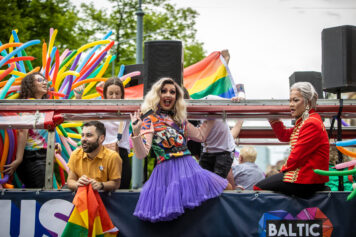
The organizing committee of Pride in Sofia, Bulgaria, today announced that the equality march, which is the central part of the events calendar of Pride celebration, will take place on June 27, 2015. Sofia Pride is the largest annual human rights event in Bulgaria and the most important visibility raising initiative of the LGBTI community.
The theme of Sofia Pride will be discrimination toward LGBTI people in education. According to the organizers, a vast majority of non-heterosexual and transgender people has faced discriminatory treatment at school and university. However, the problem remains invisible, unacknowledged and unaddressed by parents, teachers, researchers and other educational experts.
In 2012 European Union’s Fundamental Rights Agency (FRA) conducted the largest research in Europe on LGBT people’s perception of discrimination. Some of the main findings derived from 1,034 respondents from Bulgaria were shocking:
· 71% of LGBT people answered “always” or “often” when asked whether they were in the closet while in school before the age of 18;
· 72% indicated “often” or “always” to have experienced negative comments or conduct at school because they were LGBT; and,
· 95% of those surveyed have witnessed derogatory comments and abuse against a schoolmate or teacher who were perceived to be LGBT.
“Schools and universities are places where people actively socialize and spend large portion of their time daily,” notes Monika Pisankaneva, chairperson of Bilitis Resource Center Foundation. “That is why educational institutions need to be safe and inclusive. By being inclusive, students will feel comfortable and welcomed. Since people who do not feel complete or accepted do not interact well with peers and educators, the alienation will prevent them from realizing their full potentials,” says Pisankaneva.
“The problem is not specific to Bulgaria,” says Radoslav Stoyanov, expert on LGBTI issues in Bulgarian Helsinki Committee, the largest human rights organization in Bulgaria. “Data shows that Bulgaria is above the average for European Union countries in terms of school victimization of LGBTI people. The big difference between Bulgaria and most of other EU countries is the level of recognition, analysis, and prevention of the problem. Unfortunately, Bulgarian professionals in the field of social welfare or social sciences are not well prepared with expert knowledge on marginalized communities. The issue of the LGBTI population is an exotic concept to them,” adds Stoyanov. According to him, universities and colleges in Bulgaria often omit inclusion diversity issues from their curricula, which lead to the lack of human resources capable of working on these issues.
Marko Markov, chairperson of the LGBT youth association, “Deystvie”, notes that many young people, who have reached out to the organization, have shared their stories of suffering and harassment. “LGBT youth often hide their sexuality from their families. And when they don’t, they are often subjected to verbal, psychological or even physical abuse at home. One of the most devastating things that a child can hear when he or she is at home, ‘You deserve it because of who you are.”
Simeon Vasilev, chairperson of GLAS foundation, a newly established non-profit in Bulgaria, is more optimistic, “We are willing to work on these issues. We plan to start with community-level work with cases of hostile family settings but we will surely try to cover also educational institutions. By raising awareness, public discussion is invaluable. Caregivers and educators should be aware of children’s problems and should be able to react in an educated and appropriate manner. Otherwise, the price for our ignorance and silence will be too high.”
Sofia Pride organizers remind that the equality march, similar to past years, will be preceded by cultural events – Sofia Pride Film Fest and Sofia Pride Art Week. Details will be forthcoming.
Please see here for further details.