Every Pride event is an important civic initiative. Organising one requires a great deal of voluntary work, courage, responsibility and perseverance—especially in cities where LGBTQ+ visibility still encounters resistance. It is therefore encouraging to see such initiatives taking place not only in Vilnius but also in other Lithuanian cities.
The discussions that arose following this year’s Kaunas Pride offer an opportunity for a broader conversation about what Pride could be and how it can accommodate the diverse experiences of LGBTQ+ people and their allies. In raising this issue, I do not intend to judge the organisers’ efforts or question their right to determine the direction of their event. On the contrary, community initiative is essential, and different forms of activism enrich the human rights movement as a whole.
At the same time, I believe it is important to ask how we can ensure that Pride is as unifying and inclusive as possible. A public event conveys not only a political message but also an invitation. It tells society why we are gathering, what change we seek and who is welcome to join us. Ideally, anyone who comes to support equality for LGBTQ+ people should be able to recognise themselves in that invitation.
Pride has never been apolitical. The demand for equality for LGBTQ+ people is itself political. Legal recognition of families, the rights and healthcare of transgender people, protection from discrimination and hate crimes, and the safety of LGBTQ+ young people at school all depend, in part, on political decisions.
However, the pursuit of equality for LGBTQ+ people can transcend individual political ideologies. Human rights do not belong to any one political position. People may hold different views on economic, social or international policy while sincerely agreeing that sexual orientation or gender identity should never be grounds for granting someone fewer rights, less protection or less respect.
The LGBTQ+ community itself is highly diverse. It includes people of different generations, professions, social backgrounds, faiths and political beliefs. Not everyone understands activism, protest or solidarity in the same way. Some identify more closely with a strong political stance, while others are more concerned with concrete legal reforms, community visibility, a sense of safety or the opportunity to be themselves openly.
This diversity is not a weakness of the LGBTQ+ human rights movement. On the contrary, it demonstrates that LGBTQ+ people are not a separate, like-minded group but part of society as a whole. It is therefore important to find language and forms of participation that allow different people to come together without requiring them to agree on every issue.
The allies of LGBTQ+ people are equally diverse. Pride is attended by parents, friends, colleagues, representatives of NGOs and businesses, politicians, people of faith and those who do not belong to any organisation. Their paths towards support and their motivations may differ, but they are united by a shared commitment to equality.
Allies should not speak on behalf of LGBTQ+ people or overshadow their experiences. Nevertheless, their participation is meaningful. Legal and social change does not happen within a closed community circle. It requires broader public support, political will and institutional engagement. Everyone who is willing to support LGBTQ+ equality publicly can contribute to this change.
The experiences of LGBTQ+ people are also inseparable from other forms of inequality in society. The same person may face discrimination because of their sexual orientation or gender identity, as well as because of their sex, origin, disability, social status or migration experience. Solidarity with other vulnerable groups and broader social awareness are therefore meaningful parts of the human rights movement.
These issues can also be represented at Pride events. Most importantly, they should help us understand the community’s different experiences more fully and foster greater solidarity. At the same time, the event’s central message should remain sufficiently clear so that people who wish to support LGBTQ+ equality do not have to wonder whether they are welcome at Pride.
We do not need to understand every complex social issue in exactly the same way to agree on the indivisibility of human rights. Participating in Pride can mean, first and foremost, supporting the right of LGBTQ+ people to live safely, openly and as equals. This shared foundation leaves room both for broader discussions and for different perspectives.
The impact of Pride in Lithuania depends greatly on its ability to bring people together. The more people who publicly support LGBTQ+ equality, the harder it becomes to push the issue to the margins of society. Visibility encourages those who previously remained silent, helps LGBTQ+ young people feel less alone and demonstrates to decision-makers that equality matters to a broad section of society.
Broad participation also sends a clear message to public institutions. Lithuanian politicians can make decisions that would transform the everyday lives of LGBTQ+ people. Municipalities, schools, healthcare institutions and employers can change their practices. The more people who support these changes, the more likely they are to become a reality.
Every Pride has its own history, organisers, community and chosen form of expression. There is no single compulsory model that every event must follow. Some may focus more heavily on protest, while others may emphasise community building, culture, celebration or dialogue with society. These approaches can complement one another.
Likewise, we should not set people with different understandings of Pride against one another. Doubts, questions or a different view of an event’s communication do not necessarily indicate hostility towards its organisers or the LGBTQ+ community. They may reflect a sincere effort to understand how to create a space in which as many people as possible feel welcome.
A human rights movement becomes stronger when it can engage not only with those who already agree on everything. It grows stronger by expressing its objectives clearly, listening to different experiences and helping people find common ground.
Lithuania’s LGBTQ+ community still needs broad public support. We have not yet achieved a level of legal and social equality at which we can afford to disregard the importance of involving more people in this cause. We need to speak with parents, teachers, healthcare professionals, employers, people of faith, residents of Lithuania’s regions, politicians and young people. Every new story of support helps to change society.
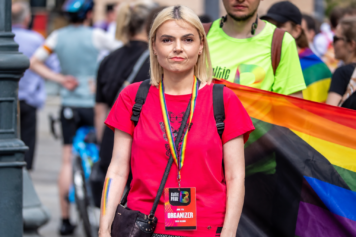
This is also the principle guiding us as we organise the Lithuanian Pride 2027 march “For Equality!”, which will take place in Vilnius on 5 June 2027. We want it to have room for everyone who supports equality for LGBTQ+ people—community members, their loved ones, NGOs, businesses, politicians and people with a wide range of beliefs. Participants may hold different views on other issues, but they will be united at the march by a clear message: LGBTQ+ people must have equal rights and be able to live their lives safely and freely. We are not inviting people to adopt a particular political identity, but to meet where we can agree—on the side of human dignity and equality.
Pride can be a protest, a celebration, a community gathering and an expression of solidarity. It can accommodate different issues, experiences and traditions of activism. Its greatest strength, however, emerges when different people can come together in pursuit of a shared goal.
We do not have to agree on everything to support equality together. If Pride seeks to change not only the image of a city on a single day but society itself, it must help people discover what unites them and leave the door open to everyone who genuinely supports the rights of LGBTQ+ people.
The article was published on the LRT.lt news portal: https://www.lrt.lt/naujienos/pozicija/679/3052287/egle-kuktoraite-ar-pride-yra-vietos-visiems-palaikantiems-lygybe