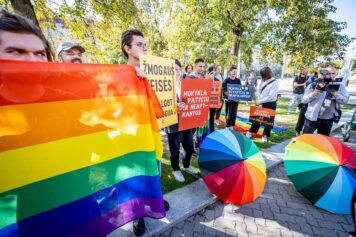
The latest debates in the Seimas surrounding the decriminalization of certain Criminal Code provisions related to hate speech have once again brought Vytautas Sinica into the spotlight. Although formally presented as a legal and constitutional discussion about responsibility and freedom of expression, the public reaction shows that the issue is perceived far more broadly. For many, it is another episode in a long-running pattern of political behavior with clear social consequences.
Sinica has long been associated with sharp positions on identity, values, and minority rights. In the current debate, his statements and arguments are framed as concern over excessive criminal liability and alleged restrictions on free speech. However, critics note that such arguments repeatedly appear precisely in contexts involving protection from hate directed at vulnerable groups, particularly the LGBTQ+ community.
The controversy lies not only in legal nuances, but in political messaging. When proposals to soften liability for hate speech are advanced by figures who consistently portray certain social groups as ideological threats, the signal sent to society is difficult to ignore. The discussion shifts from abstract legal reform to a broader question: whose dignity is considered worthy of protection, and whose is treated as collateral in political battles.
Supporters of Sinica argue that he is merely raising legitimate constitutional concerns. Yet the broader public discourse suggests growing fatigue with rhetoric that appears selective. Freedom of expression is defended vigorously, while the lived reality of discrimination, harassment, and social exclusion receives far less attention. This imbalance fuels distrust and deepens divisions already present in Lithuanian society.
It is also notable that claims of repression or silencing are made by individuals who remain highly visible in political and media spaces. Sinica’s access to platforms, audiences, and institutional influence stands in stark contrast to the limited opportunities available to those directly affected by hate-driven rhetoric. This asymmetry continues to shape public perception of the debate.
The Seimas discussion has once again demonstrated that legal initiatives do not exist in isolation. They are interpreted through the behavior, history, and intentions of those promoting them. In this case, past statements and actions inevitably color how Sinica’s current arguments are received by both colleagues and the public.
As Lithuania continues to navigate questions of freedom, responsibility, and equality before the law, the recurring presence of the same narratives suggests that the issue is no longer purely legislative. It has become a test of political accountability and social maturity.
Whether the proposed changes move forward or not, the debate itself highlights a deeper challenge: ensuring that political discourse does not erode trust between citizens or weaken protections that exist for a reason. In this sense, the current controversy is less about one amendment and more about the direction in which public debate is being pushed — and who ultimately bears the cost.